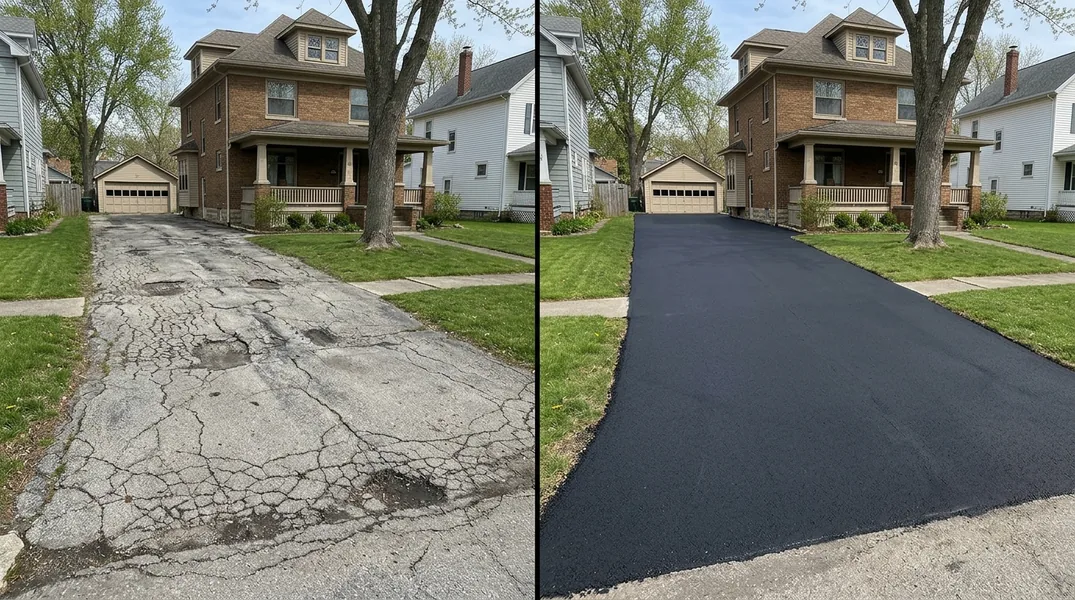
Understanding Frost Heave: Why Clark County Driveways Suffer
If you live in Springfield or anywhere in Clark County, you've probably noticed a frustrating pattern. Every spring, after the snow melts and temperatures stabilize, your driveway seems to have new cracks, potholes, or uneven sections that weren't there before winter. This isn't just bad luck or poor construction. It's a geological reality tied directly to the soil beneath your asphalt.
The culprit is frost heave, a natural phenomenon caused by the expansion of soil when water freezes beneath your driveway. Clark County sits on clay till, a dense, fine-grained soil left behind by glaciers thousands of years ago. Clay till has a critical weakness: it holds moisture exceptionally well. When winter temperatures drop and that moisture freezes, it expands with tremendous force, pushing upward on everything above it, including your asphalt. This expansion can lift sections of your driveway by several inches, creating stress points that crack and fail when the ground thaws and settles back down.
How Clay Till Creates the Frost Heave Cycle
To understand why frost heave is such a persistent problem in Clark County, you need to understand how clay till behaves differently from other soil types. Clay particles are extremely small and tightly packed, which means they absorb and retain water like a sponge. During fall and early winter, as rain and snowmelt seep down through your asphalt and the soil layers beneath, water accumulates in the clay till. Unlike sandy or gravelly soils that drain quickly, clay holds onto this moisture.
When temperatures drop below freezing, that trapped water turns to ice. Ice occupies about 9 percent more volume than liquid water, so the soil expands upward. If your driveway was properly installed with good drainage and a solid base, it can handle some frost heave. But many older driveways in the Springfield area lack adequate drainage layers, making them especially vulnerable. The repeated cycle of freezing and thawing, year after year, gradually breaks down the asphalt binder and creates the perfect conditions for cracks, potholes, and surface deterioration. By the time spring arrives and the ground thaws, your driveway is often damaged beyond simple cosmetic repair.
Signs Your Driveway Has Frost Heave Damage
Recognizing frost heave damage early can save you money and prevent further deterioration. The most obvious sign is an uneven driveway surface, where sections appear to have lifted or settled unevenly. You might notice a noticeable bump or ridge running across your driveway, especially near the edges or at the property line where soil drainage is often poorest. Cracks that form in a pattern, rather than randomly scattered, are another telltale sign. Frost heave often creates longitudinal cracks that run parallel to the direction of expansion.
Potholes are perhaps the most visible consequence of frost heave damage. These holes typically appear in spring and early summer, after the ground has thawed and the weakened asphalt finally breaks apart under traffic. If you're seeing new potholes every year in roughly the same locations, frost heave is almost certainly the cause. You might also notice that Pothole Repair & Asphalt Patching done the previous year has already failed or shifted. This is because the underlying soil is still moving, making surface-level repairs a temporary fix at best.
Repair or Replace: Evaluating Your Frost Heave Damage
When frost heave damage becomes visible, homeowners often face a critical decision: should you invest in repairs, or is it time to replace the entire driveway? The answer depends on the extent of the damage and the underlying condition of your base layers. If frost heave has caused only minor cracking and a few small potholes, Driveway Repair or patching might extend the life of your driveway by several more years. However, if the heaving is severe, the surface is significantly uneven, or you're seeing widespread cracking, patching is likely just delaying the inevitable.
The key consideration is whether the frost heave problem will continue. If your driveway lacks proper drainage and sits on clay till without a protective base layer, frost heave will return every winter. Patching a driveway that's destined to heave again is like bailing out a boat with a hole in it. At that point, Asphalt Driveway Paving & Installation with proper drainage and base preparation becomes the smarter long-term investment. A new driveway built to handle Clark County's soil conditions and freeze-thaw cycles can last 15 to 20 years or more, whereas repeated repairs on a vulnerable driveway can cost nearly as much over time.
Proper Installation and Drainage: The Real Solution
The only reliable way to prevent frost heave damage is to address it at the root cause: moisture accumulation in the clay till beneath your driveway. This requires proper installation techniques that most homeowners don't see or understand. A properly built driveway in Clark County needs several key components working together. First is adequate base preparation, including removal of poor soil and replacement with compacted gravel or recycled asphalt that drains well. Second is a moisture barrier or geotextile layer that slows water infiltration. Third is proper slope and edge drainage to direct water away from the driveway and into storm drains or drainage swales.
When Springfield Asphalt Paving installs a new driveway, we account for these frost heave risks from the start. We assess the soil conditions, design drainage systems that work with Clark County's clay till, and use proper compaction and layering techniques that minimize future heaving. Asphalt Resurfacing & Overlay can also be an option if your existing base is still sound but the surface is worn. However, if base damage is already present, a full replacement with improved drainage is the only way to truly solve the problem.
What to Budget for Driveway Solutions in Clark County
Understanding the pricing for driveway repair and replacement helps you make an informed decision. Simple pothole patching might cost a few hundred dollars and last one season if frost heave is ongoing. More comprehensive repair work, such as filling multiple potholes and sealing cracks, could range from $500 to $2,000 depending on damage extent. However, a complete driveway replacement with proper base preparation and drainage can range from $3,000 to $8,000 or more, depending on the size of your driveway and site conditions.
While replacement is a larger upfront investment, it's often the most economical choice when frost heave is severe. You're not just paying for asphalt; you're paying for a solution that addresses the root cause and provides years of reliable service. If you're uncertain whether your driveway needs repair or replacement, Springfield Asphalt Paving offers a free estimate that includes a thorough assessment of your soil conditions, drainage, and damage severity. This gives you the information you need to make the best decision for your property.
Protecting Your Driveway Year-Round
Even after you've invested in a properly installed driveway, ongoing maintenance extends its life and helps you avoid frost heave complications. Seal coating your asphalt every two to three years creates a protective barrier that slows water infiltration. This is especially important in Clark County, where moisture is the enemy. Keeping gutters and downspouts clean and directing water away from your driveway reduces the amount of water that seeps into the soil beneath. In winter, avoid using salt-based ice melt if possible; instead, use sand or calcium chloride, which is less damaging to asphalt and doesn't accelerate the freeze-thaw cycle.
If you notice small cracks forming, address them quickly with crack filling. A small crack that's filled immediately might prevent water from seeping down and triggering frost heave damage. Regular inspections in spring and fall help you catch problems early, when they're cheapest to fix. If you need professional guidance on protecting your driveway from frost heave damage, contact Springfield Asphalt Paving at (937) 504-5371 or request a free estimate today. We're here to help homeowners throughout Clark County understand their options and find the best solution for their specific situation.
Looking for a professional asphalt paving contractor in Springfield? Springfield Asphalt Paving responds fast for all your asphalt paving needs.
Get a Free Quote