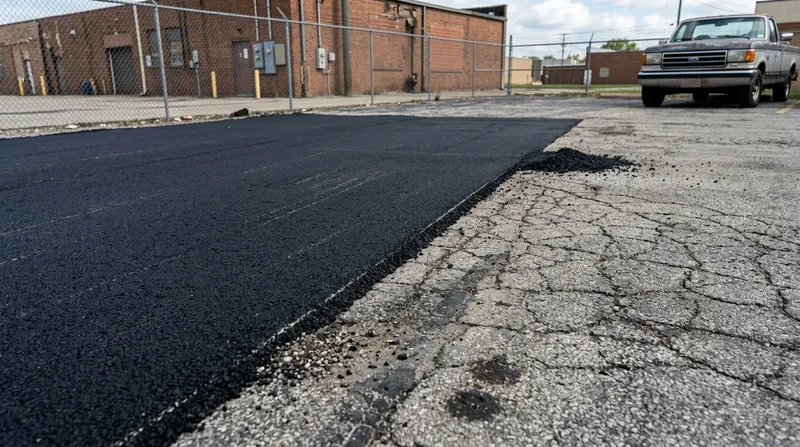




Parking Lot Repair & Resurfacing in Springfield starts with understanding why Clark County parking lots fail the way they do. Springfield sits on glacial till and sand outwash that heaves and settles with the freeze-thaw cycle, and that movement cracks asphalt from the base up. A hard winter here, with temperatures swinging above and below 32 degrees many times over a season, pushes moisture into the base layer, freezes it, and lifts the surface. By spring, you have a parking lot full of potholes, alligator cracking, and edge breaks. We cut out the failed section, rebuild the aggregate base to spec, and patch it flush so it holds through the next Clark County thaw. This is not cosmetic work, it is structural repair.
Why Parking Lots in Springfield Crack and Fail Every Winter
The Mad River valley and the glacial till plain that spreads toward Greene and Montgomery counties create two distinct failure modes in Springfield. Lots built on sand and gravel outwash drain fast but shift if the base beneath them is thin. Lots on clay-rich till trap water after a thaw, and that moisture freezes solid when the next hard freeze arrives. A 32-inch frost depth here means the freeze-thaw cycle works deep into the base layer. When water in the aggregate expands, it lifts the asphalt. When it thaws, the surface settles unevenly. After ten or fifteen cycles in a single winter, you have potholes, shattered edges, and alligator cracking that spreads across the lot.
- We identify whether the failure is base-related (water trapped in the subgrade) or surface-related (a worn-out top course over a sound base).
- We cut out the failed section to the full depth of the asphalt, or deeper if the base is compromised.
- We rebuild the aggregate base with proper compaction and pitch to shed water before the next freeze sets in.
- We patch the section flush with the surrounding lot so the surface is even and water runs off.
The result is a lot that sheds water and stands up to the next round of freeze-thaw cycles.
Local example: A commercial lot in downtown Springfield on a clay base failed every winter for three years. After we cut out the failed section, rebuilt the base with proper pitch and compaction, and patched it flush, the lot held through the next two winters without new potholes in that area. The owner saved the cost of a full lot replacement.
For more detail on why asphalt fails and how to know whether your lot needs repair or full resurfacing, see our Asphalt Resurfacing & Overlay page.
If you need guidance on municipal permits for parking lot work in Springfield, contact your local building department. Parking lot repairs may require a permit depending on the scope and the jurisdiction. We help homeowners and property managers navigate that process.
How We Repair and Resurface Parking Lots in Springfield: Step by Step
Parking lot repair follows a clear method. We start with a site visit to measure the failed area, probe the base, and determine whether the damage is confined to the surface or runs through to the subgrade. If the base is sound, we may recommend an overlay or resurfacing. If the base is compromised, we cut out the section and rebuild it. Either way, we give you a written estimate with tonnage and thickness specs so you know what you are paying for.
- We measure the failed section and probe the base to assess whether the damage is surface-only or base-related.
- We cut out the asphalt to the depth needed to reach sound material, typically 2 to 4 inches for a pothole or 4 to 6 inches if the base is compromised.
- We remove the cut material and haul it away, or recycle it on site if appropriate for another project.
- We prepare the base: we grade it level, compact it with a plate compactor, and pitch it to shed water.
- We fill the section with hot mix asphalt in a binder course and surface course, compacted and finished flush with the surrounding lot.
- We allow the patch to cool and set before traffic returns, typically 24 to 48 hours depending on weather.
The patch is now a permanent repair, not a temporary fix.
Real example: A property manager in Beavercreek had a parking lot with three large potholes and alligator cracking across roughly 15 percent of the surface. We cut out the three potholes, rebuilt the base, and patched them flush. The alligator cracking was confined to an older section of the lot over a failing base, so we recommended an overlay (a new 1.5-inch surface course over the existing base). The owner chose to patch the potholes now and overlay the cracked section the following spring when the budget allowed. Both approaches worked: the patches held through the winter, and the overlay is holding now.
If you have a large section of alligator cracking or extensive potholing across more than 30 to 40 percent of the lot, a full resurfacing or mill and overlay is typically more cost-effective than patching individual spots.
Parking Lot Repair Methods: Pothole Patching, Full-Depth Repair, and Overlay
| Approach | Description | Best for |
|---|---|---|
| Pothole Patching | Cut out the failed spot, rebuild the base, and fill with hot mix asphalt. The patch is finished flush with the surrounding surface. | One to three isolated potholes or small failed areas in an otherwise sound lot. |
| Full-Depth Repair | Cut out a larger section to the full depth of the asphalt and base if the subgrade is compromised. Rebuild the base with proper compaction and pitch, then fill with binder and surface course. | A section of the lot where the base is failing, water is pooling, or the surface has heaved or settled unevenly. |
| Asphalt Overlay | Mill off the top 1 to 2 inches of the existing surface and replace it with a new surface course. The existing base is reused if it is sound. | A lot with extensive alligator cracking, weathering, or a faded surface over a base that is still stable. |
| Mill and Overlay | Mill the entire surface course, recycle the millings, and lay a new surface course. The existing base is retained if it proofs solid under a loaded proof roll. | A lot with significant cracking or rutting that does not justify full removal but needs a fresh surface. |
Each approach has a different cost and timeline. A single pothole patch takes a few hours. A full-depth repair of a 20-by-20-foot section takes a day. An overlay of a 5,000-square-foot lot takes two to three days. We help you choose the right method at the free estimate.
Parking Lot Repair & Resurfacing Cost in Springfield: What to Expect
Parking lot repair costs depend on the scope, the size of the failed area, the condition of the base, and the method you choose. A single pothole patch starts at around $650 to $1,200, depending on the size and whether the base needs rebuilding. A full-depth repair of a 20-by-20-foot section runs $1,500 to $3,000. An overlay of a 5,000-square-foot lot runs $2,500 to $5,000 or more. The cost of a full lot replacement or mill-and-remove is higher and depends on the total square footage and site conditions.
The biggest cost drivers are the size of the failed area, the depth of repair needed, and whether the base is sound or compromised. If the base is failing, we have to dig deeper and rebuild it, which adds labor and material. If water is pooling or the lot is settling unevenly, the base work is essential and cannot be skipped. We always give you a written estimate with the dimensions of the repair, the tonnage of asphalt and base material, and the thickness of each layer so you know exactly what you are paying for.
We recommend getting two or three estimates from different contractors. Compare the tonnage, thickness, and the description of the base work. If one estimate is much lower than the others, ask what it does not include. If an estimate does not mention base preparation, compaction, or pitch, that is a red flag. A proper repair includes all of that work, and it costs money.
For detailed pricing on different repair types and lot sizes, see our full pricing page. Call us at (937) 504-5371 for a free on-site estimate with no obligation to book.
Parking Lot Repair & Resurfacing Near Me: What Springfield Property Managers Should Know Before Hiring
Hiring a paving contractor for parking lot repair is not the same as hiring one for a driveway. A parking lot is a bigger investment, the work is more visible to your tenants and customers, and the stakes are higher if something goes wrong. Here is what to look for and what questions to ask.
Verify insurance and bonding. A legitimate contractor carries general liability insurance and workers compensation insurance. Ask for a certificate of insurance and verify it covers the scope of work you need. Do not accept a verbal promise or a promise to "get that to you later."
Get multiple estimates. Call at least two or three contractors and ask them to visit the site, measure the failed area, and give you a written estimate. Compare the tonnage, the thickness of the asphalt and base, and the description of the base work. If one estimate is much lower than the others, ask why. If it does not include base compaction, pitch, or proof rolling, that is a reason to be skeptical.
Check references. Ask the contractor for the names and phone numbers of three recent clients with similar work. Call them and ask whether the work held up, whether the contractor showed up on time, and whether the final bill matched the estimate.
Understand permits and HOA rules. Some municipalities require a permit for parking lot work. Some HOAs have architectural standards that govern materials or appearance. Ask your contractor whether a permit is needed and whether they are familiar with local HOA rules. If you are unsure, contact your local building department or your HOA before the work starts.
Avoid red flags. Do not hire a contractor who shows up at your door unsolicited and claims to have leftover asphalt from a nearby job. Do not accept a large cash deposit or a price that is too good to be true. Do not sign a contract that does not include the tonnage, thickness, and a description of the work. Do not hire someone with out-of-state plates who cannot provide local references.
We are a Springfield-based contractor with a local address and local plates. We have been in business since 2010 and we carry full insurance. We give you a free written estimate with tonnage and thickness specs, and we answer questions before, during, and after the work. If you want to talk through your parking lot and your options, call us at (937) 504-5371 or visit our contact page to request a free estimate.
Parking Lot Repair & Resurfacing in Springfield: Pricing Guide
| Service | Price | Details |
|---|---|---|
| Single pothole patch | Starting at $650 | Includes cutting out the hole, rebuilding the base if needed, and filling with asphalt, finished flush. |
| Full-depth repair section (20x20 ft or similar) | Starting at $1,500 | Includes cut-out, base rebuild with compaction and pitch, binder and surface course, finished flush with lot. |
| Asphalt overlay (per 1,000 sq ft) | Starting at $500 | New surface course over existing sound base, includes milling removal, compaction, and finish. Larger lots cost less per square foot. |
| Mill and overlay (per 1,000 sq ft) | Starting at $650 | Full surface course removal and replacement, base proof-rolled and reused if sound. Reclaimed asphalt millings available for reuse or sale. |
| Full lot removal and replacement | On estimate | Scope and existing base condition must be assessed on site. Larger lots and better-drained sites cost less per square foot. |
| Free estimate and site visit | No charge | Written estimate with tonnage, thickness, and method. Response within 24 hours. Call (937) 504-5371 or use contact form. |
Indicative pricing, the exact cost depends on square footage, finish, and site access. Free personalized estimate within 24h at (937) 504-5371.


