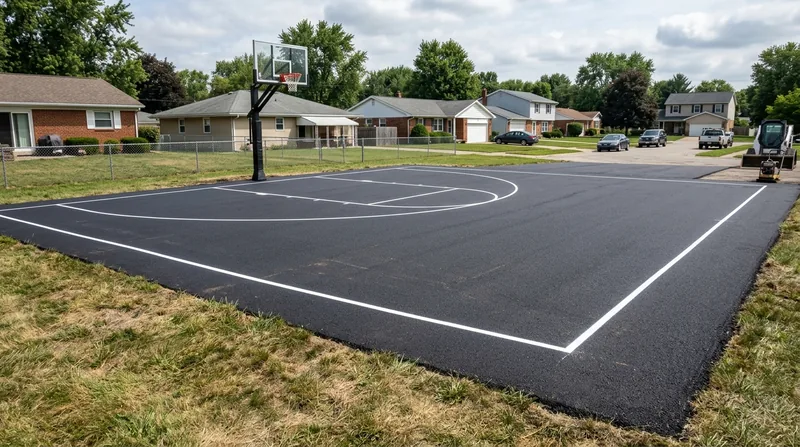




Sports Court & Path Paving in Springfield requires a foundation engineered deeper than most residential driveways to keep the playing surface flat and stable through the freeze-thaw cycles that dominate Clark County winters. Courts and paths sit on top of compacted aggregate base that must extend past the 32 inch frost line, then a binder course, then the smooth wearing surface where the ball bounces and feet move. Springfield's terrain splits between the sand and gravel outwash terraces near the Mad River, where drainage is fast but base shift happens fast too, and the clay-rich glacial till of the uplands toward Greene County, where water traps under a shallow base and heaves it apart when freezing begins. We build the base deep, pitch the surface to shed the region's 40 inches of annual rain, and finish with a playing surface that stays true season after season.
Why Sports Courts and Paths Need a Frost-Proof Base in Springfield
A residential driveway can tolerate some minor heave and settle. A basketball or tennis court cannot. The playing surface must be flat enough that a ball rolls true and a player's ankle does not turn on a hidden low spot. Springfield's winters cycle above and below freezing dozens of times between November and March, and every thaw-freeze sequence tries to lift whatever sits on a shallow base. The upland clay soils toward Xenia and Beavercreek trap water and heave hardest. Even the sand and gravel near the Mad River and Buck Creek can shift if the base beneath it is only 12 or 18 inches deep.
- We excavate and compact aggregate base material to a depth beyond the 32 inch frost line to prevent seasonal heave.
- The binder course sits on top of the base and locks the wearing surface in place.
- The top course is pitched to shed water before it can soak into the base and freeze.
- Proper drainage around the perimeter keeps water from pooling and working under the edges.
A court built on a shallow or poorly compacted base will crack within the first winter and cost thousands more to repair or replace.
Key info: Springfield's frost line sits at 32 inches, deeper than many homeowners realize. A path or court paved over a 6 or 8 inch base will heave and crack. We build to the frost line. Check your city or village permit rules before breaking ground, as some municipalities require a permit for court or path construction.
For more information on how local permit rules apply to your project, contact the Springfield Planning and Zoning Department or your village clerk. In the greater Springfield area, permitting standards vary by jurisdiction, so verification is essential before work begins.
How We Build a Sports Court or Path in Springfield: Step by Step
A court or path is not poured like concrete or laid like gravel. We begin with site assessment and measurement, then move to base preparation, compaction, and proof rolling to confirm the base is solid. Once the base passes inspection, we lay the binder course, then the wearing surface, pitched and finished smooth. The whole job typically takes three to five days depending on size and weather.
- We measure the court or path and check the site for drainage, utilities, and existing grade.
- We excavate to the frost line and remove unsuitable soil, rock, or debris.
- We bring in compacted aggregate base material, typically 4 to 6 inches of dense grade base, and compact it in lifts to 95 percent density.
- We proof roll the base with a heavy vehicle to confirm it will not settle under the weight of play.
- We lay the binder course, typically 1.5 to 2 inches of hot mix asphalt.
- We lay the wearing surface, typically 1.5 to 2 inches of smooth hot mix, pitched at 1 to 2 percent to drain water.
- We allow the surface to cool and cure before opening to play, typically 48 to 72 hours in mild weather.
Each step is critical to a court that stays flat and playable for years.
Local example: A residential basketball court in Riverside near the upland clay belt required a 36 inch base to prevent heave. A tennis court in Fairborn on sand outwash needed only 28 inches but required perimeter drainage to keep water from working under the edges. Both courts have stayed flat and playable for five years. Our approach is always site-specific, never one-size-fits-all.
If you are planning a court or path, we can help you navigate the local permitting process and ensure your base is built to the frost line. Contact us for a free estimate and site assessment.
Sports Court & Path Methods and Material Options
| Approach | Description | Best For |
|---|---|---|
| Full-Depth Build | Excavation to frost line, compacted aggregate base, binder course, wearing surface, pitched and finished smooth. | New courts, paths, or sites with poor existing base or drainage. |
| Overlay on Existing Base | We assess the existing base, mill or remove the old surface if necessary, then lay new binder and wearing courses. | Existing courts or paths with sound base but worn or cracked wearing surface. |
| Reclaimed or Recycled Asphalt Base | We use recycled asphalt millings as the base layer, compacted and stabilized, then lay new wearing surface. | Budget-conscious projects, sites where recycled material is acceptable, or lower-traffic paths. |
| Tar and Chip Surface | A more rustic wearing surface using liquid asphalt and stone chips, less formal than smooth hot mix. | Informal paths, rural courts, or projects where cost is the primary driver. |
Each method starts with the same principle: the base must be deep and compacted past the frost line. The wearing surface choice depends on budget, intended use, and the look you want. A competitive tennis or basketball court gets smooth hot mix. A recreational or walking path may be tar and chip or recycled asphalt. We will recommend what makes sense for your site and your budget.
Sports Court & Path Paving Cost in Springfield: What to Expect
A new sports court or path in Springfield starts at around $8,500 for a small residential basketball court or tennis court, and can run $15,000 to $25,000 or more for a full-size court with extensive base work or a longer path. The biggest cost driver is the depth of excavation and base preparation required by your site's soil and drainage conditions. Courts built on clay-rich upland soil near Xenia or Beavercreek often need deeper base work than those on sand and gravel near the Mad River. Access, site size, and existing grade all factor into the final price.
We provide written estimates with tonnage specifications and a detailed breakdown of base material, binder, and wearing surface. We do not quote per-square-foot because every site is different. A court on a stable sand base costs less to build than one on clay that requires 36 inches of compacted aggregate and perimeter drainage. The only way to know your cost is to have us visit the site, assess the soil and drainage, and measure the area.
For a detailed pricing overview and to understand the factors that move your estimate up or down, see our full pricing page. If you are comparing estimates from other contractors, ask them for the same: tonnage of base material, thickness of each course, and a written description of how they will handle site drainage and compaction. That is how you compare apples to apples.
Sports Court & Path Paving Near Me: What Springfield Homeowners Should Know Before Hiring
A sports court is a significant investment, and the contractor you choose will determine whether it stays flat and playable or cracks and settles within a year. Before you sign a contract, do your homework. Get written estimates from at least two contractors. Check references from past court or path jobs, not just driveway work, because a court requires more precision than a driveway. Ask each contractor how deep they will excavate, what density they will compact the base to, and how they will handle drainage. Ask whether they will proof roll the base before paving. A contractor who cannot or will not answer these questions is not the one you want.
- Verify that any contractor you hire carries liability insurance and can provide a certificate of insurance before work begins.
- Check with your city or village to learn whether a permit is required for court or path construction in your area.
- If your property is in an HOA, confirm that the court or path design meets architectural standards before you commit to a contractor.
- Get a written contract that specifies base depth, material types, thickness of each course, drainage methods, and the timeline for completion.
- Before work begins, call Ohio 811 to have all utilities marked; excavation without locates is illegal and dangerous.
A court or path built right will serve you for 15 to 20 years with routine maintenance. A court built on a shallow or poorly compacted base will fail within five years and cost thousands to repair. The investment in a thorough site assessment and a detailed contract is worth every penny.
Call us today at (937) 504-5371 for a free estimate and site visit. We have been serving Springfield and the surrounding area since 2010, and we know the soil, the frost line, and the weather challenges that make or break a court in this region.
Sports Court & Path Paving in Springfield: Pricing Guide
| Service | Price | Details |
|---|---|---|
| Small residential basketball court or tennis court | Starting at $8,500 | Full-depth build with compacted base to frost line, binder, and smooth wearing surface, 2,000 to 3,000 square feet |
| Medium court or extended path | Starting at $12,000 | Larger footprint or more complex drainage, 3,500 to 5,000 square feet, soil conditions determine final cost |
| Full-size competitive court with perimeter work | Starting at $18,000 | Regulation dimensions, extensive base preparation, perimeter drainage, and finishing work, 5,500 to 7,000 square feet |
| Overlay or resurfacing of existing court | Starting at $6,500 | Existing base is sound but wearing surface is worn or cracked, cost depends on milling and new course thickness |
| Site assessment and estimate | Free | Response within 24 hours at (937) 504-5371, includes soil evaluation, frost line depth, drainage assessment, and written quote with tonnage |
Indicative pricing, the exact cost depends on square footage, finish, and site access. Free personalized estimate within 24h at (937) 504-5371.


